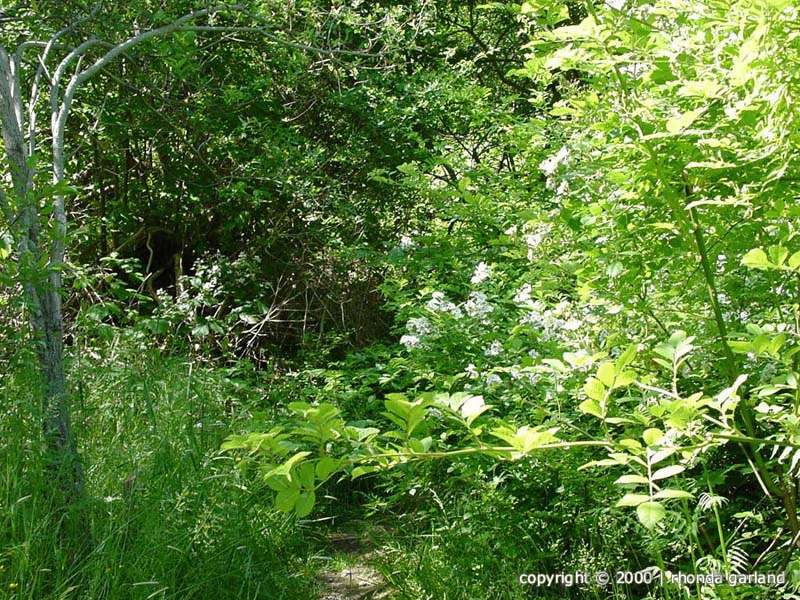
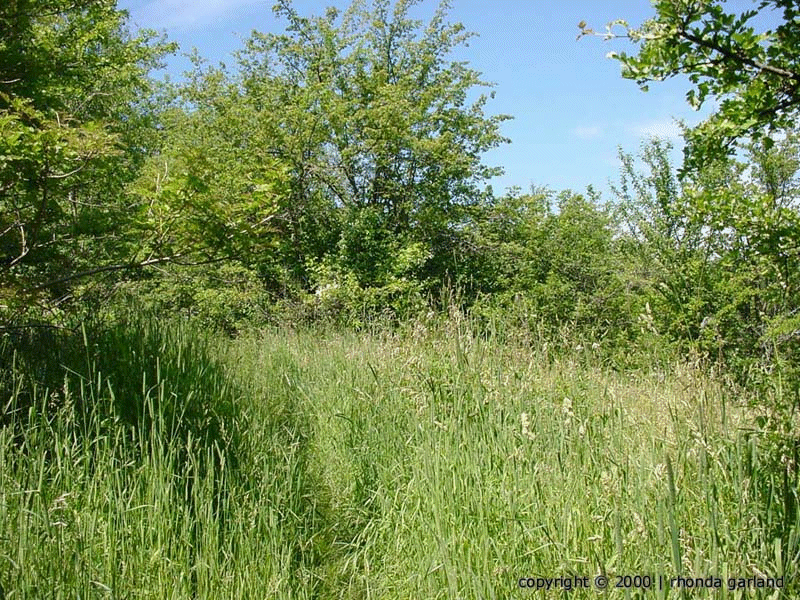
In the area that used to be an apple orchard many apple trees still survive. However, the area no longer looks like an orchard.The reason for this is that succession has taken place. Succession is defined as an orderly (i.e., predictable) change in community composition over time culminating in a more or less stable or climax community. Why does succession takes place? The facilitation model of succession, which dominated ecological thinking up until the 1960s, states that each stage in the successional sequence prepares the site for the next stage and makes it unsuitable for its own growth (e.g., the first plants to colonize the site add nutrients to the soil and make it suitable for the next group of organisms). In reality, there are relatively few documented cases of early pioneers which make the site more suitable for later colonists. These few examples occur largely in the case of primary succession (i.e., succession on a site that did not previously support life - e.g., the crushed rock fragments left by a retreating glacier). In cases of secondary succession (i.e., succession on a site that previously supported life - e.g., succession after a forest fire, clear cutting or after agricultural land is abandoned), the neutral and inhibition models of succession predominate.
In these models, the early colonists either have no effect upon growth of later colonists or inhibit the growth of later colonists. Succession, therefore, takes place because of differences in the life histories of the various colonists (i.e., differences in dispersal ability, growth rates, life span and final size). In other words, early colonists are species that can disperse to new sites rapidly and have rapid growth rates and therefore, are very noticeable in the early stages of succession. Later successional species take longer to reach new sites or grow more slowly so that even if they reach a new site early, they are not very apparent. On the other hand, they may live longer and reach a greater final size and will therefore, come to dominate in later years. In this particular early successional community, bird dispersed and wind dispersed plants are dominant. Some of the species found in this area include:
